
Prepare for your OSP Fiber Permit Design Interview Questions & Answers covering ROW permits, utility coordination, 811, boring, AutoCAD, GIS, QC and permit workflows.
If you are preparing for an OSP Fiber Design Engineer, Permit Design Engineer, or Google Fiber/GFiber interview, understanding permit design, Right-of-Way (ROW), utility coordination, construction requirements, and permit drawings is essential.
A Permit Design Engineer is responsible for preparing fiber routes and construction drawings that comply with the requirements of local authorities, property owners, utilities, and other stakeholders. During an interview, employers may test both your technical knowledge and your understanding of the permit submission workflow.
This guide covers 20 important OSP fiber permit design interview questions and answers, including ROW permits, encroachment permits, access agreements, boring permits, utility locating, pole attachments, AutoCAD, GIS, QC, and permit rejection.
Important: Permit names, requirements, construction restrictions, and approval procedures can vary by city, county, state, utility owner, and project. Always verify the applicable local requirements for the specific project.
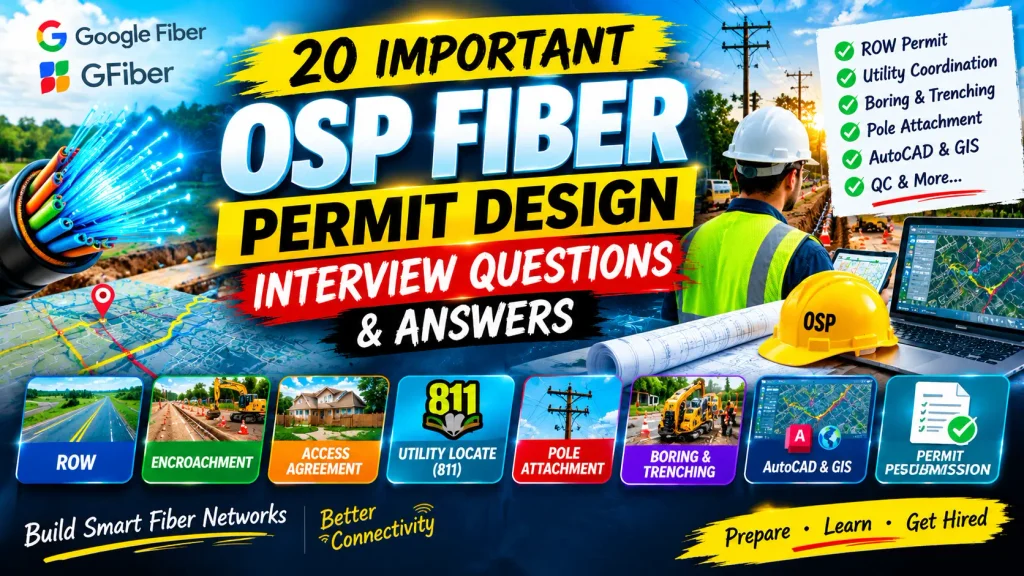
OSP Fiber Permit Design Interview Questions & Answers
1. What is a Permit in OSP Fiber Design?
A permit is an official approval obtained from the relevant authority, property owner, or other controlling entity before fiber-optic construction can be performed in a particular area.
For an OSP fiber project, permits help ensure that proposed construction complies with applicable requirements for:
- Public roads
- Sidewalks
- Rights-of-way
- Private properties
- Utility corridors
- Railroads
- Highways
- Other controlled areas
A Permit Design Engineer must identify the applicable jurisdiction and prepare the required drawings and supporting documents before submission.
2. What is ROW?
ROW stands for Right-of-Way.
A Right-of-Way is a legally controlled area reserved for transportation, utilities, or other public infrastructure. Depending on the location, it may include roads, sidewalks, public corridors, and utility areas.
In fiber deployment, the ROW is important because proposed fiber routes may need to occupy or cross areas controlled by a public or local authority.
3. What is a ROW Permit?
A ROW permit is permission from the responsible authority to perform construction work within a public Right-of-Way.
For example, if an underground fiber route requires construction within a public road corridor or sidewalk area, the responsible authority may require a ROW permit before construction begins.
The permit drawing generally needs to show the proposed route, construction method, dimensions, crossings, and other information required by the jurisdiction.
4. What is an Encroachment Permit?
An encroachment permit may be required when proposed construction occupies or impacts an area controlled by another authority.
Examples can include:
- Roads
- Sidewalks
- Public property
- Transportation corridors
- Other controlled areas
The exact definition and requirements vary by jurisdiction, so a Permit Design Engineer should review the authority’s current requirements before preparing the submission.
5. What is an Access Agreement or ROE?
An Access Agreement or Right of Entry (ROE) provides permission to access private property for activities such as:
- Fiber surveys
- Construction
- Installation
- Maintenance
- Inspection
Private properties can include multifamily buildings, gated communities, private roads, and other locations where the fiber construction team does not automatically have public access.
Before construction, the design and permitting team should confirm that the necessary access rights are available.

6. What is the Difference Between Public ROW and Private Property?
The key difference is who controls access and construction permissions.
| Public ROW | Private Property |
|---|---|
| Controlled by a public/local authority | Controlled by the property owner or manager |
| May require ROW or encroachment permits | May require owner/manager permission |
| Construction follows authority requirements | Access may require an Access Agreement or ROE |
| Public infrastructure corridor | Privately controlled land or facilities |
A fiber route can cross both public and private areas, so the Permit Design Engineer must identify the applicable permission for each section.
7. What is a Traffic Control Permit?
A Traffic Control Permit is an approval associated with construction activities that affect traffic, pedestrians, lanes, sidewalks, or other transportation movements.
Depending on the project, traffic-control requirements may include:
- Signs
- Barricades
- Lane closures
- Pedestrian protection
- Work-zone protection
- Temporary traffic-control measures
The exact requirements depend on the authority and construction location.
8. What is a Boring Permit?
A boring permit is an approval associated with trenchless construction, such as horizontal directional drilling (HDD), where fiber or conduit is installed underground without conventional open excavation across a controlled crossing.
Boring may be considered for locations such as:
- Roads
- Railways
- Highways
- Other restricted crossings
The permit package may need to include information about the proposed boring path, depths, crossing details, and construction methodology.
9. When Should You Choose Boring Over Trenching?
Boring may be considered when open excavation is undesirable, restricted, or impractical.
Typical examples include:
- Major road crossings
- Railway crossings
- Congested areas
- Locations with restrictions on surface excavation
- Areas where maintaining traffic or access is important
However, the final construction method depends on site conditions, authority requirements, existing utilities, constructability, and the approved design.
10. What Information Do You Check Before Permit Submission?
Before submitting a permit package, a Permit Design Engineer should perform a detailed review of the proposed route.
Important items include:
- Fiber route
- ROW boundaries
- Property boundaries
- Existing utilities
- Road and sidewalk impacts
- Utility crossings
- Construction method
- Proposed dimensions
- Traffic-control requirements
- Access requirements
- Permit jurisdiction
- Supporting drawings and documents
This pre-submission review helps identify potential issues before the permit is submitted.
11. What is Utility Locate / 811?
811 is the U.S. Call Before You Dig system used to help identify underground utility infrastructure before excavation.
Utility locating is an important part of underground fiber construction because existing utilities may be located along or near the proposed fiber route.
The design and construction process should account for utility information and applicable clearance requirements.
For a specific project, the responsible team should follow the applicable state and local utility-locate procedures.
12. Why is Utility Coordination Important?
Utility coordination helps identify existing underground and overhead utilities and reduces the risk of conflicts during fiber construction.
It is particularly important when the proposed fiber route crosses or runs near:
- Gas lines
- Water lines
- Electric utilities
- Telecommunications infrastructure
- Sewer systems
- Other underground facilities
Identifying conflicts during design can help reduce construction changes, redesign, delays, and the risk of utility damage.
13. What is Pole Attachment?
A pole attachment involves placing fiber-optic cable or related equipment on an existing utility pole.
Before proposing a pole attachment, the design team may need to review:
- Available pole space
- Existing attachments
- Applicable clearance requirements
- Pole ownership
- Structural considerations
- Applicable regulations
- Coordination with other parties
The specific approval process depends on the pole owner and applicable jurisdiction or utility requirements.
14. What if Your Proposed Route Conflicts With an Existing Utility?
If a proposed fiber route conflicts with an existing utility, the first step is to verify the utility information and the proposed route.
Then review:
- Required clearances
- Separation requirements
- Crossing details
- Construction methodology
- Utility-owner requirements
If the conflict cannot be resolved through the proposed construction method, the route may need to be modified.
The updated route and construction details should then be reflected in the permit drawing before submission.
Interview Tip
Instead of simply saying, “I will change the route,” explain your process:
Verify → Analyze conflict → Check requirements → Coordinate → Modify design → Update drawing → QC → Submit
15. What is a Permit Drawing?
A permit drawing is a construction or design drawing prepared according to the requirements of the applicable authority.
It typically communicates information such as:
- Proposed fiber route
- Road crossings
- Utility crossings
- Construction dimensions
- Existing utilities
- Construction methods
- ROW information
- Notes and annotations
- Traffic-control information
- Other jurisdiction-specific details
The drawing must be clear and accurate because it is used during the permit review and can also support construction activities.
16. What is the Role of AutoCAD in Permit Design?
AutoCAD is commonly used for preparing and modifying detailed engineering and permit drawings.
In OSP fiber permit design, a designer may use CAD software to:
- Draw fiber routes
- Show dimensions
- Add utility information
- Prepare crossing details
- Add construction notes
- Modify alignments
- Add annotations
- Prepare permit sheets
- Update drawings after review comments
Strong CAD skills are therefore useful for a Permit Design Engineer.
17. How Can GIS Help in OSP Permit Design?
GIS (Geographic Information System) helps engineers visualize and analyze geographic and spatial information.
In OSP fiber design, GIS can help visualize:
- Fiber routes
- Roads
- Parcels
- Utilities
- Poles
- Existing infrastructure
- Property boundaries
- Geographic features
GIS analysis can help identify potential conflicts and provide useful information before detailed CAD permit drawings are prepared.
Simple Interview Answer
“GIS helps me understand the spatial relationship between the proposed fiber route and existing roads, utilities, parcels, and other infrastructure. I can use that information to identify potential conflicts before finalizing the permit design.”
18. What if a Permit is Rejected?
If a permit is rejected, the first step is to carefully review the authority’s comments.
A good workflow is:
Review comments → Identify required changes → Revise design → Update drawings → Perform QC → Resubmit
It is important to understand why the permit was rejected rather than simply resubmitting the same design.
Example Interview Answer
“If a permit is rejected, I first review every comment from the authority, identify the design or documentation issue, make the required revisions, perform QC, and then resubmit the corrected permit package.”
This demonstrates a structured approach to permit comments.
19. What is QC in Permit Design?
QC stands for Quality Control.
QC is the process of checking the permit design and supporting documents for accuracy and completeness before submission.
A permit QC review may include:
- Route accuracy
- Dimensions
- Utility information
- Road crossings
- Utility crossings
- Clearances
- Annotations
- Construction details
- Permit requirements
- Supporting documents
A thorough QC process can help identify errors before the authority reviews the permit package.
20. Explain Your Permit Design Workflow
This is one of the most important questions for a Permit Design Engineer interview.
A typical workflow can be explained as:
Requirements → Base Map Review → ROW/Property Review → Utility Review → Route Design → Crossing Review → Drawing Preparation → QC → Permit Submission → Comment Tracking → Revision → Approval → Construction Information Maintenance
Sample Interview Answer
“First, I review the project requirements, base maps, ROW and property information. Then I review existing utilities and identify potential conflicts. After that, I develop the fiber route and determine the appropriate construction methods and crossings. I prepare the permit drawings and supporting documents according to the jurisdiction’s requirements. Before submission, I perform a detailed QC review. After submission, I track authority comments, make the required revisions, perform QC again, and resubmit until approval. Once approved, I maintain the latest information for the construction team.”
Key Skills for an OSP Fiber Permit Design Engineer
A successful Permit Design Engineer should have a combination of technical, design, coordination, and documentation skills.
1. OSP Fiber Design
Understand underground and aerial fiber deployment, routes, crossings, and construction methods.
2. Permit Knowledge
Understand ROW, encroachment, boring, traffic-control, access, and other jurisdiction-specific requirements.
3. AutoCAD
Be comfortable creating and modifying detailed permit and construction drawings.
4. GIS
Understand spatial data and use mapping information to support route planning and conflict identification.
5. Utility Coordination
Be able to identify existing utilities and account for applicable clearance and separation requirements.
6. Quality Control
Review drawings carefully before submission and ensure that permit packages meet project and authority requirements.
7. Comment Resolution
Know how to analyze permit comments, revise designs, and resubmit corrected documents.
8. Communication
Permit design often requires coordination with authorities, utility owners, property owners, engineers, construction teams, and other stakeholders.
Final Thoughts
Preparing for an OSP Fiber Permit Design Engineer interview Question requires more than memorizing definitions. Interviewers may want to understand how you approach real-world design and permitting problems.
Focus particularly on the complete process:
Route Review → ROW/Property Analysis → Utility Coordination → Construction Method → Permit Drawing → QC → Submission → Comments → Revision → Approval
You should also be prepared to explain how you would handle practical situations such as a utility conflict, permit rejection, road crossing, private-property access issue, boring requirement, or missing permit information.
Most importantly, remember that permit names and requirements vary by jurisdiction. A strong Permit Design Engineer understands the general workflow while also checking the specific requirements of the city, county, state, transportation agency, utility owner, or other authority responsible for the project.
Frequently Asked Questions
What are the most important topics for a Permit Design Engineer interview?
Important topics include ROW permits, encroachment permits, access agreements, utility coordination, 811, boring, trenching, pole attachments, AutoCAD, GIS, permit drawings, QC, and permit-comment resolution.
What software is useful for OSP permit design?
Commonly relevant tools include AutoCAD and GIS software. The exact software stack varies between companies and projects.
What is the difference between ROW and an access agreement?
A ROW permit generally relates to construction within a public or authority-controlled Right-of-Way, while an access agreement/ROE provides permission to access privately controlled property.
Why is QC important before permit submission?
QC helps identify design errors, missing information, incorrect dimensions, utility conflicts, and documentation issues before the permit package reaches the reviewing authority.
What should I do if a permit is rejected?
Review the authority’s comments, determine the required changes, revise the design and drawings, complete QC, and resubmit the corrected package.